
WealthMaster
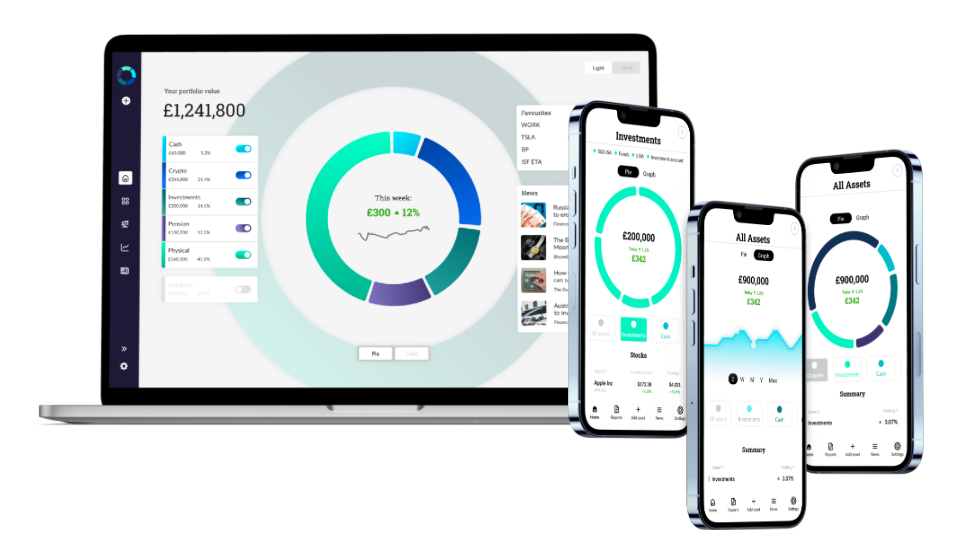
A platform to track and analyse users current finances and investments so they can have control of their future financial security.
Finance is broad topic, and people approach it in very different ways; finances can be personal and emotive, they can also be rewarding but stressful. Everyone’s financial situation is different. However, this does not change the fundamental fact that people care about their finances. Why? It’s because people want to know they can afford their current way of living, and they are going to be financially secure in the future.
The Challenge
For people with multiple financial and physical assets, knowing they can get an overview of their whole investment portfolio is important. However, keeping track of these when they’re invested across multiple platforms can be hard. The current process, which involves manually inputting data into a spreadsheet to obtain net worth values and projections, is highly inefficient, time-consuming and there is margin for error.
Our client believed people needed a way of viewing a consolidated portfolio of all their investments that would replace the current way of manually managing their assets.
To tackle this problem, our challenge was to create a platform that could aggregate multiple assets in one place, provide automatic updates and improve the overall user experience.
My role
I was part of a UX design team that undertook shared responsibilities throughout the project.
The process
Based on the challenge and the time-frame we had to deliver, we used the double-diamond framework when approaching the project.
Tools used
User research, survey, interviews, competitor analysis, market positioning, affinity mapping, archetypes, personas, task analysis, job stories, jobs-to-be done, problem statement, Figma, wire framing, prototyping, user testing.
Duration: 6 weeks

Uncovering the problem
Define
Stakeholder Meeting
Who was our client?
To get started, we needed to understand who our clients was, their vision and how they had come across the particular problem they were wanting to solve.
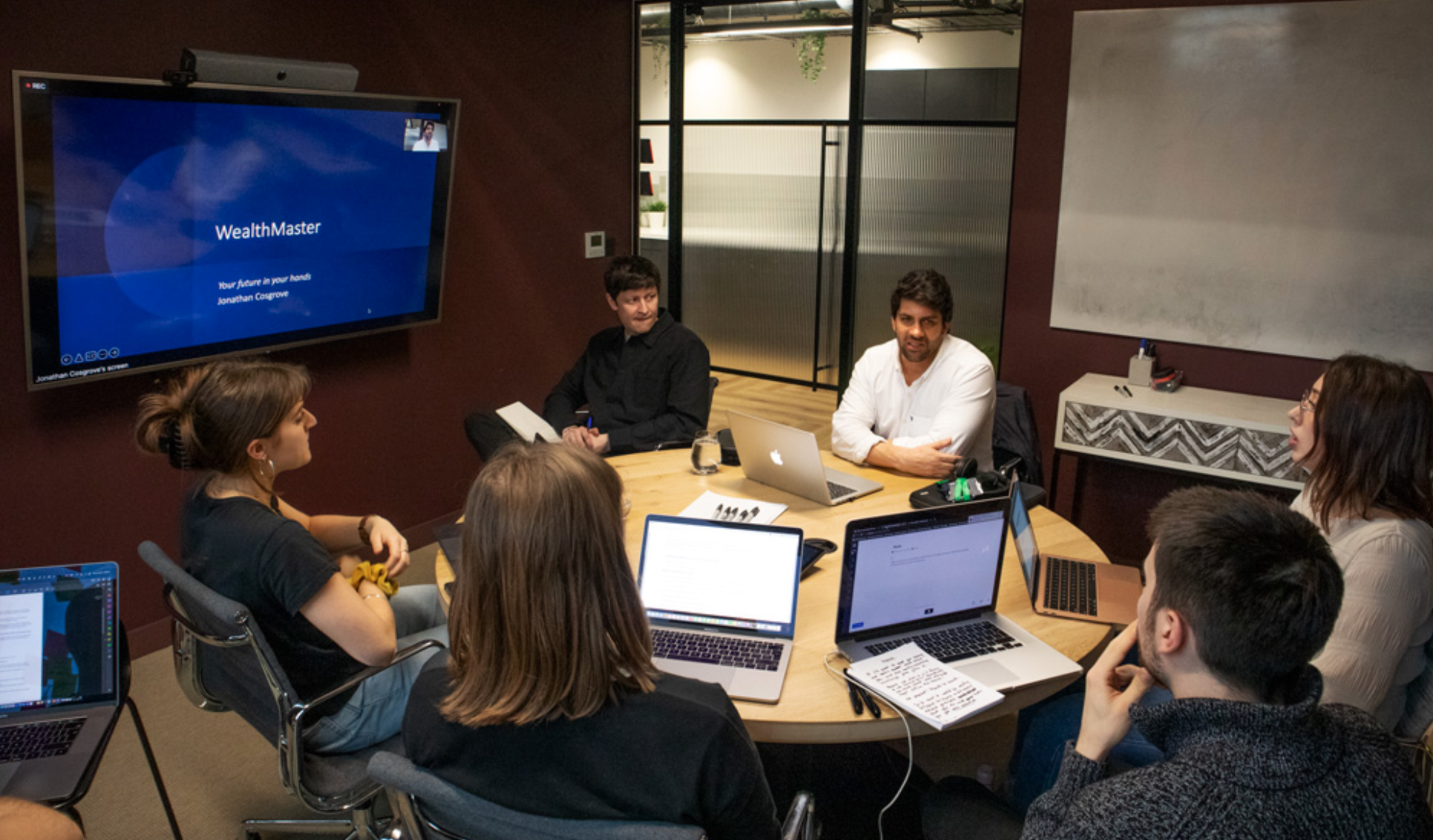
“The user journey is just beyond important, especially for the people that I’m targeting, it has to be really idiot-proof”
Our client was spending time every week having to manually pull data from all his asset accounts and input this in his own spreadsheet in order to get the financial overview and analytics he was after. Having done some of his own research, he had found he were not alone in carrying out this laborious process, and wondered if there would be a way of improving the experience of managing and tracking financial investments.
Our client believed people needed a way of viewing a consolidated portfolio of all their investments that would replace the current way of manually managing their assets.
Whilst this gave us a good foundation of where to start, we didn’t want to make any general assumptions about how people currently managed and tracked their assets and investments based on our client and the specific problems he faced. We needed to start with our own research that would inform us of what the ‘real’ problem was and would eventually become the building blocks for our solution.
Research
What did our research consist of?
From our research, we wanted to understand how and why people currently view and track their assets. We also needed to understand what other products currently existed and where they fitted in the market. To do this, we carried out:
User research
Survey
Interviews
Market research
Competitor analysis
Market positioning
User research
Who are WealthMaster’s potential clients?
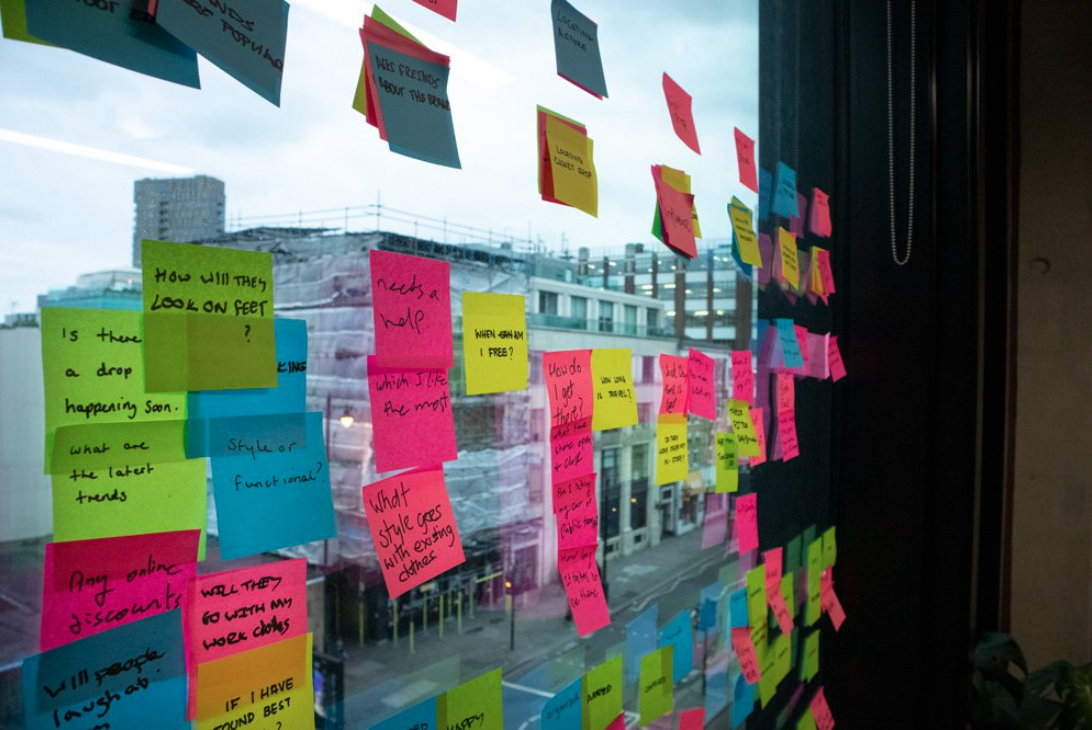
To understand who WealthMaster’s potential clients would be, we needed to understand not only how people currently view their assets, but also their behaviours, feelings and needs in relation to tracking and getting an overview of their finances and investments . We started by sending out a screener survey, which could be used later to source people to interview.
Survey
We had 25 participants complete our survey comprised of 7 questions.
Survey
What were the results?
The most popular assets to invest in were equities (39%), crypto (18%) and real estate (13%)
40% of participants use 3+ platforms to manage their portfolio
37% of participants check their portfolio weekly, with 22% checking daily
Over half track all their investments individually, with 14% using their own spreadsheet
Interviews
We now needed to understand in greater detail the approach and attitude people took when handling their finances. To do this, we constructed a discussion guide of questions based on a few key research goals; to find out how people currently track and manage their assets, why they carry it out in this way, and how they felt about changing the way they did this in the future.
We conducted 51 interviews with people we found through our own network and our clients. We spoke to wide range of people with different professions, ages and approaches to investment and risk.
What did they say?
The Process
Managing financial assets manually is confusing and time-consuming, meaning people often give up on doing it.
“Very manual, username, password, dual-identification, take down the numbers usually on a post-it note, carry them across and put them on a spreadsheet. Proper old school”
Financial Attitude
Finances are not only important, but can be daunting; people want to know that they are getting the most from their money.
“Ultimately your finances should be working for you, so that you don’t have to invest loads of time and you can concentrate on other life issues”
Getting an overview
People in general really liked the idea of having an amalgamation of all asset performances in one place.
“Instead of looking in multiple places, you could just log on and have everything in one place, that’d be great”
Affinity Mapping
Making sense of our user research
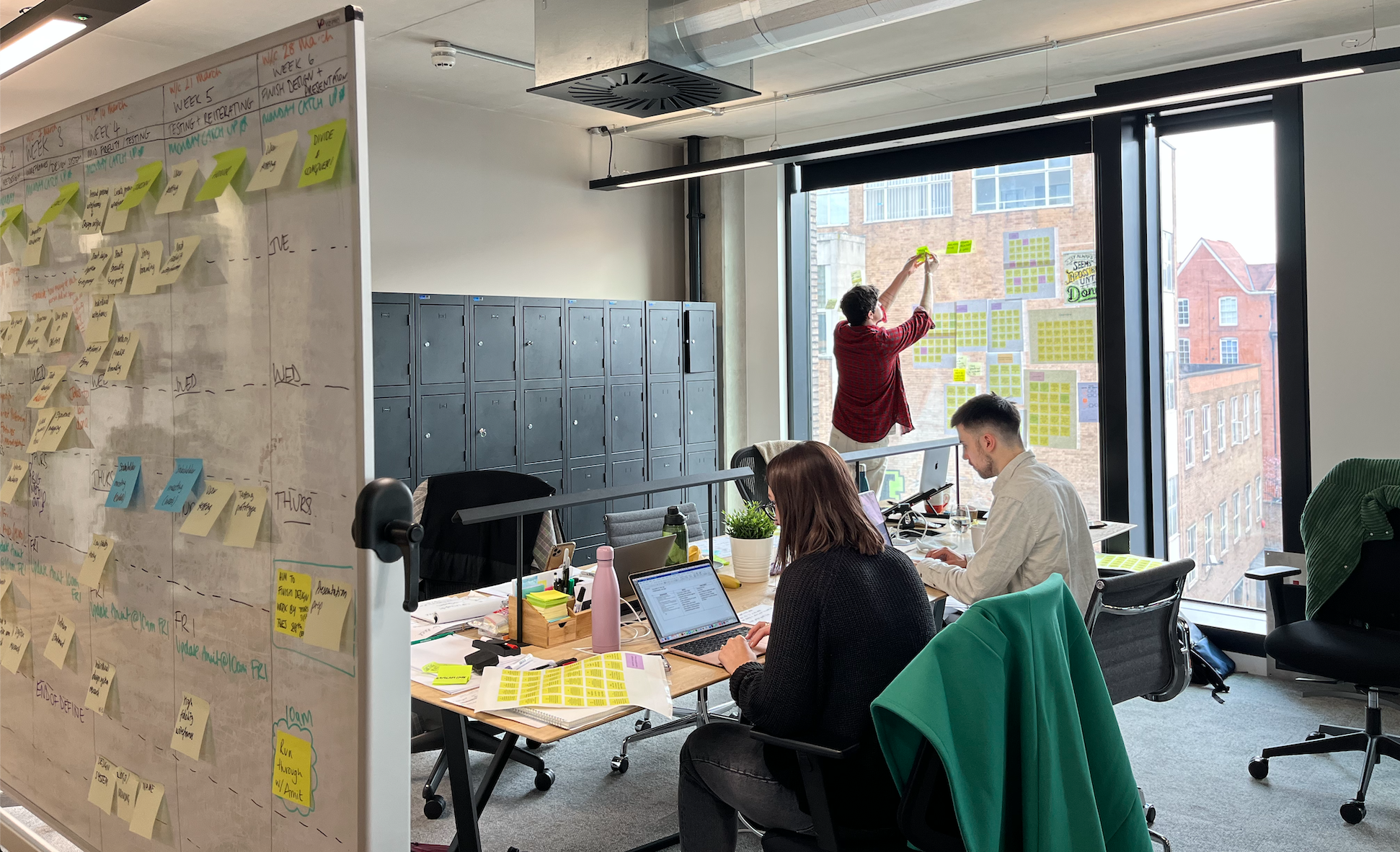
We needed to start pulling key themes and trends from our user research that would inform how we tackled the challenge. To do this, we extrapolated all of the key behaviours, emotions and defining quotes from our interviews and created an affinity map compiled over over 650 data points.

A few key trends
As we started to organise the data into groups (i.e. similar behaviours, contrasting views or clear areas of interest), we started to see some key trends appearing.
Examples of some key trends:
Trend 1: There are two clear ‘type‘s of investors
Long-Term view on investments
Many people view investments as a way to gain financial stability, protection and ‘future-proof’ themselves and their family
v.s.
Short-Term riskier approach
Whereas a smaller number want to take greater risks with their finances in the short-term to maximise returns
Trend 2: The Interest In ‘Sustainable, Responsible, Ethical’ Investing
There is a growing awareness and interest around where people’s finances are being invested, and how they can make sure their investments are being put in sustainable funds and sectors
“Socially and environmentally sustainable investments are going to be important in the future; especially when these sorts of funds become more secure and performance matches the current funds I’ve already invested in”
Trend 3 : People view physical assets differently
Some people view them as part of their liquid assets
“My house is part of my short term plan to build my net worth and make some quick money”
v.s.
While others don’t include them as an investment
“I’m probably never going to liquidate those assets so I really don’t see it as part of my net worth”
Data Synthesising
Understanding our user needs
Having synthesised all of this data we started to extrapolate these key trends in people’s behaviour and current processes. We also started to see some similarities in the emotions and needs people had when approaching their wealth management.
We identified three core pillars that defined our user-centric needs when it came to their finances and investments.
These were Control, Knowledge and Flexibility.
People want to feel in Control so they can:
1. Secure their current financial situation
If people feel like they know what they have, they can feel more confident in affording their current way of living
2. Mitigate against financial risks
So they are better prepared for unforeseen circumstances or changes that might affect their finances
3. Plan for their future
So they know they will be financial secure in the future and better set realistic financial goals
People want to have Knowledge so they can:
1. Make informed decisions
People want to make sure decisions regard their finances are based on actual reasoning as opposed to irrational judgement
2. Make their money work for them
Understanding how finances work together and where there’s growth (and maximising this)
3. Understand new investment opportunities
Being able to diversify financial portfolios and learn about new opportunities like conscious investing
People want to there to be Flexibility when it comes to their finances so they can:
1. Invest their money where they want
Having the freedom to choose how they want to invest and when they might decide to move their money around
2. Choose how to track and manage their finances
Having no set way to approach personal finances; whether managing themselves or using a wealth manager, they can decide
3. Allow their finances to adapt to fit changing circumstances
If they’re becoming a more high-risk investor or setting new goals to achieve, their finances can adapt with this
These user needs weren’t mutually exclusive, but inherently intertwined; each inform one another.
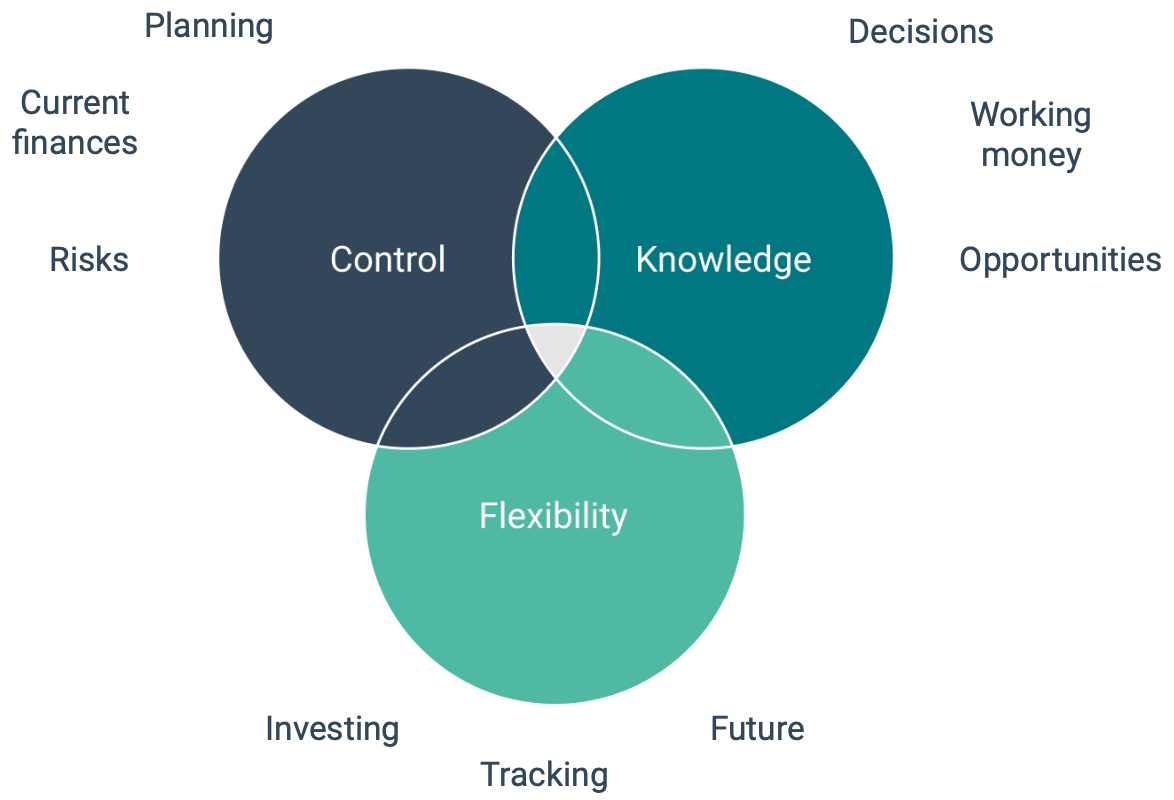
What we found was that with more knowledge, people feel more in control, and in turn will be more flexible when in how they approach and manage their finances. This control, knowledge and flexibility is what we needed to take forward when starting to define what our approach and product would be later on.
Market Research
Who are WealthMaster’s competition?
With a deeper understanding of our potential users, the next step was to understand what competitors there were in the field of financial asset tracking and management. We had various research aims, such as finding out what sort of services competitors provided, what pricing strategies they had, and what unique selling points they advertised. This would help us understand both what the market currently looked like, but also where there was a gap in the market that WealthMaster could take advantage of.
What did we find? A crowded market for wealth management platforms…
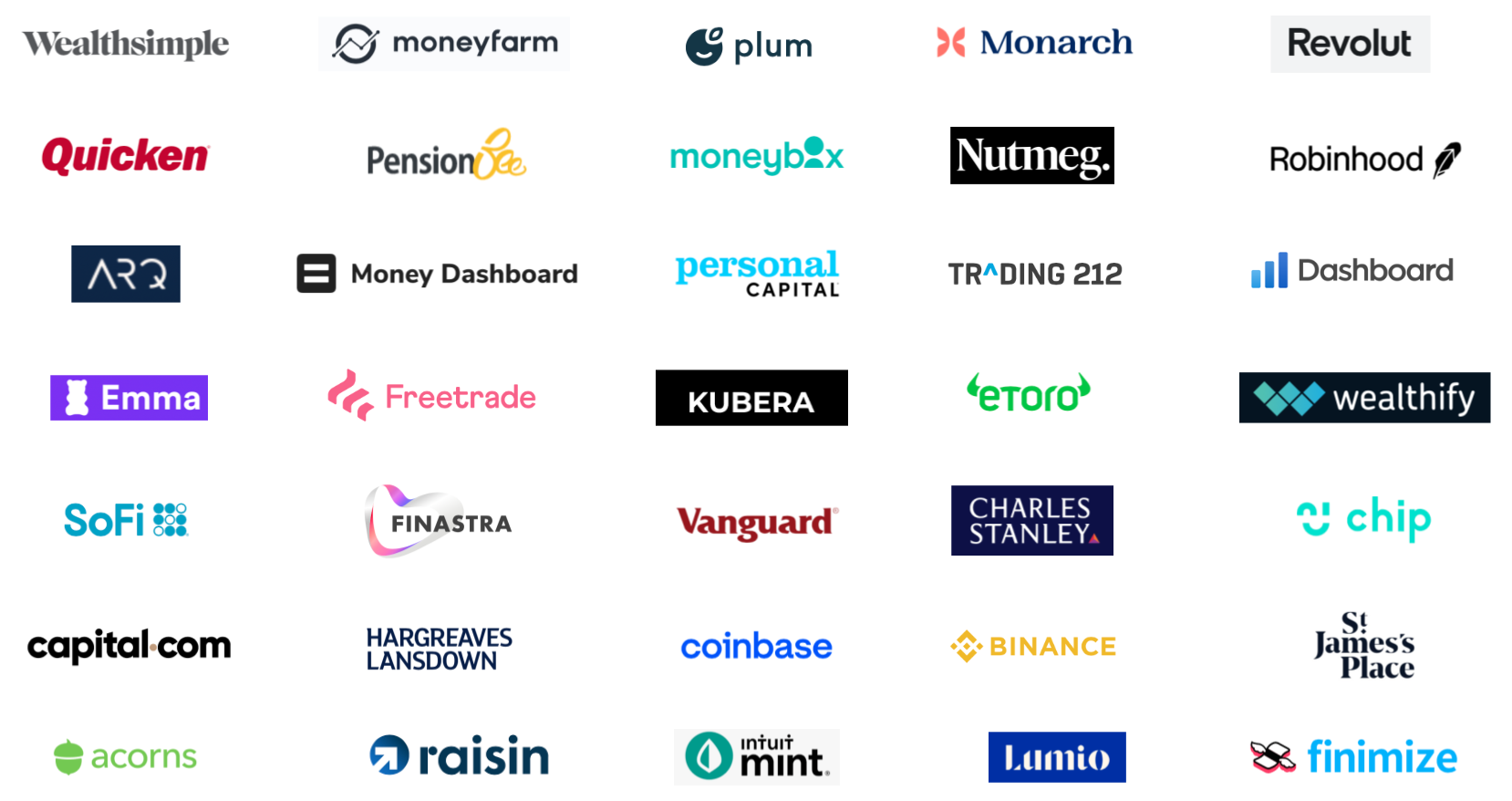
We conducted in-depth research on a variety of platforms that covered wealth management, investments, pensions, new and analytics, and banking to identify the pros and cons of each.
A few examples of our in-depth analysis of competitors:
: an online financial advisor focusing on investments and retirement tracking
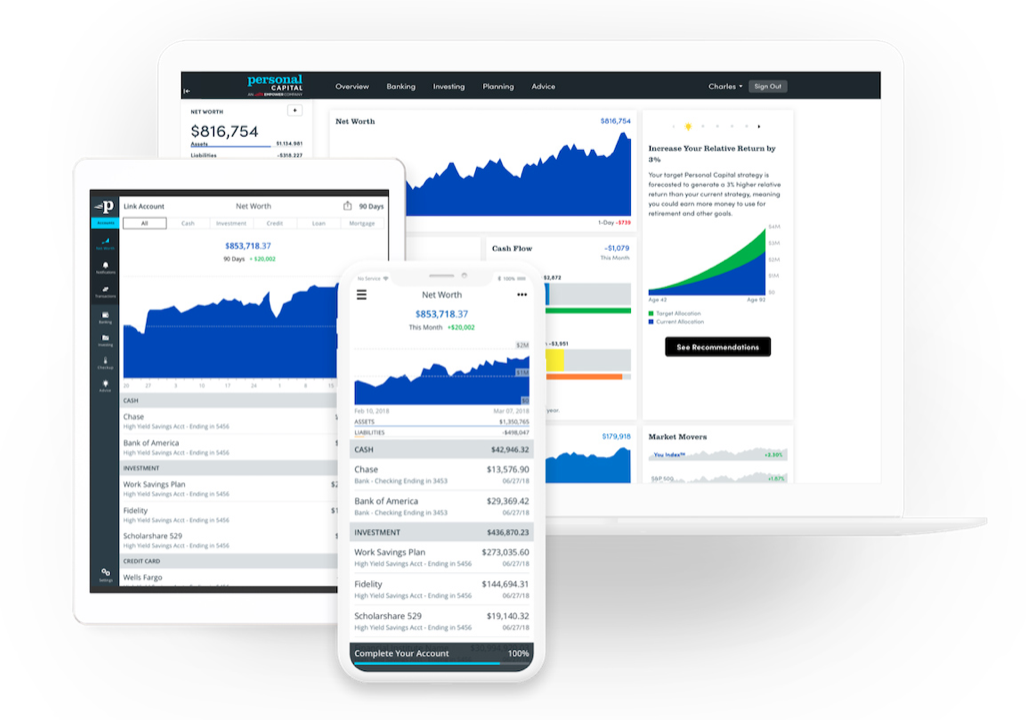
Pros
Multiple free tools & functionalities
Detailed portfolio analysis i.e. showing breakdown on sectors
Integration of physical assets
Cons
High fees
Poor returns on investment services
Account linking problems i.e. double authetification stops automatic updates

: an online financial advisor and personal wealth management company
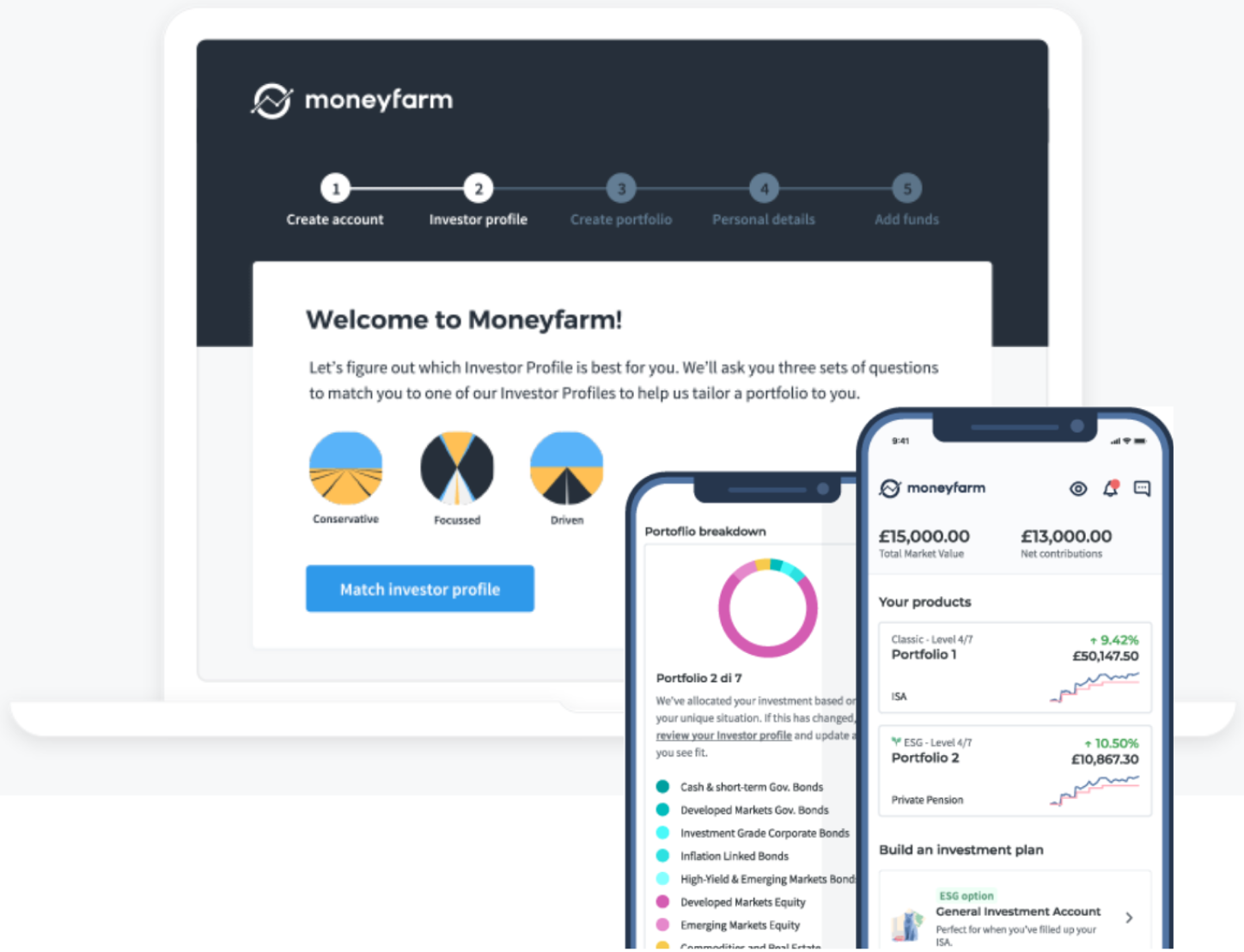
Pros
Designated investment consultant to offer users guidance & advice
No subscription or trading fees
Option to make portfolio ‘socially responsible’
Cons
Limited number of portfolio options
High investment management fees
Lacking trading functionalities; doesn’t make it a good option for experienced investors

: ‘money-saving’ and financial investment app
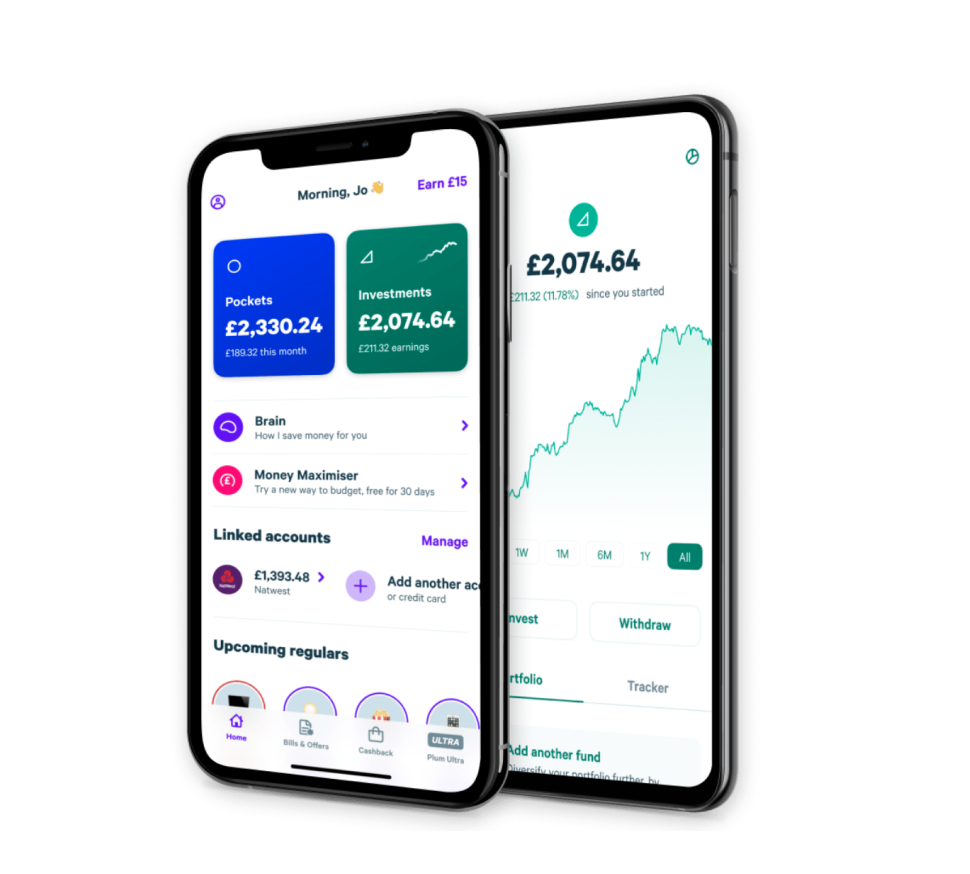
Pros
Introduces simple investing concepts and automated investing - good for first time investors
‘Brain’ function - helps user understand the AI to build trust
Simple UI without losing personal feel
Cons
Soley money and savings tracker - lacks investment functionalities
High investment fees if investing smaller amounts
Quite a few paid-for features that other apps offer for free
Brand and Styling
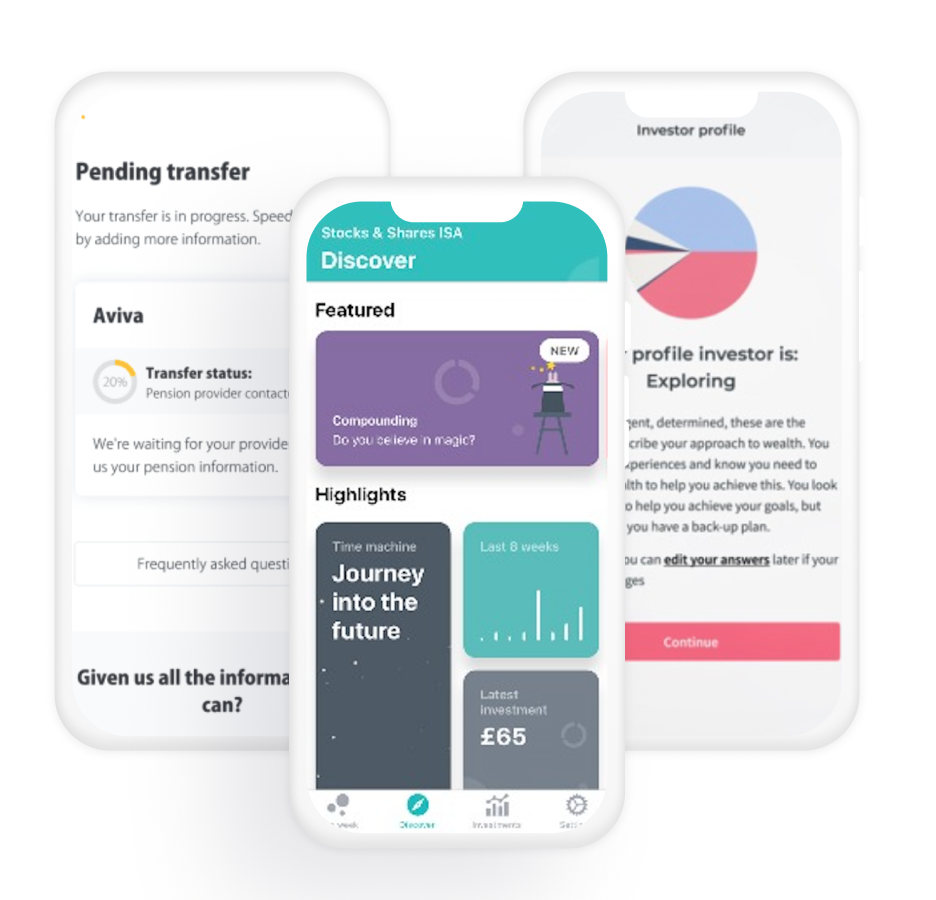
We also started to use the identify the style, design and branding from competitors websites and apps to get a better idea of what existing financial platforms look liked and what sort of range there was.
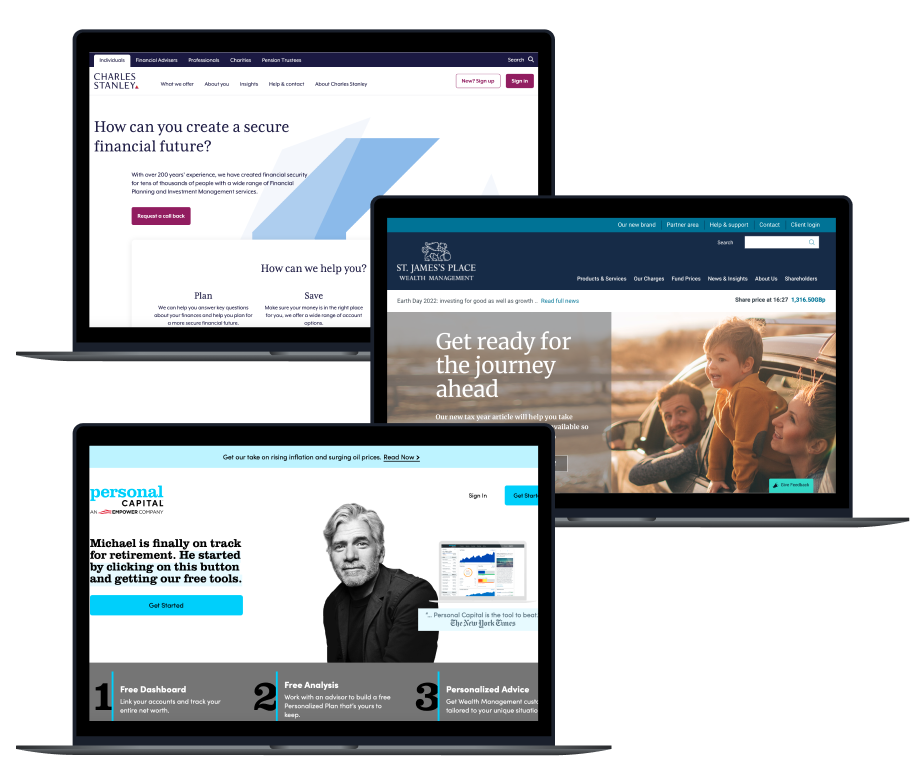
More traditional and well-established wealth management services tended to fell more functional and corporate such as St James Place, Charles Stanley and Personal Capital.
Whilst newer financial management platforms felt more modern, accessible and interactive like Moneyfarm, PensonBee and MoneyBox.
Market positioning
We then used this research to plot competitors on a graph to cross-compare the ‘feel’ of the platforms against the number of assets a user could integrate.
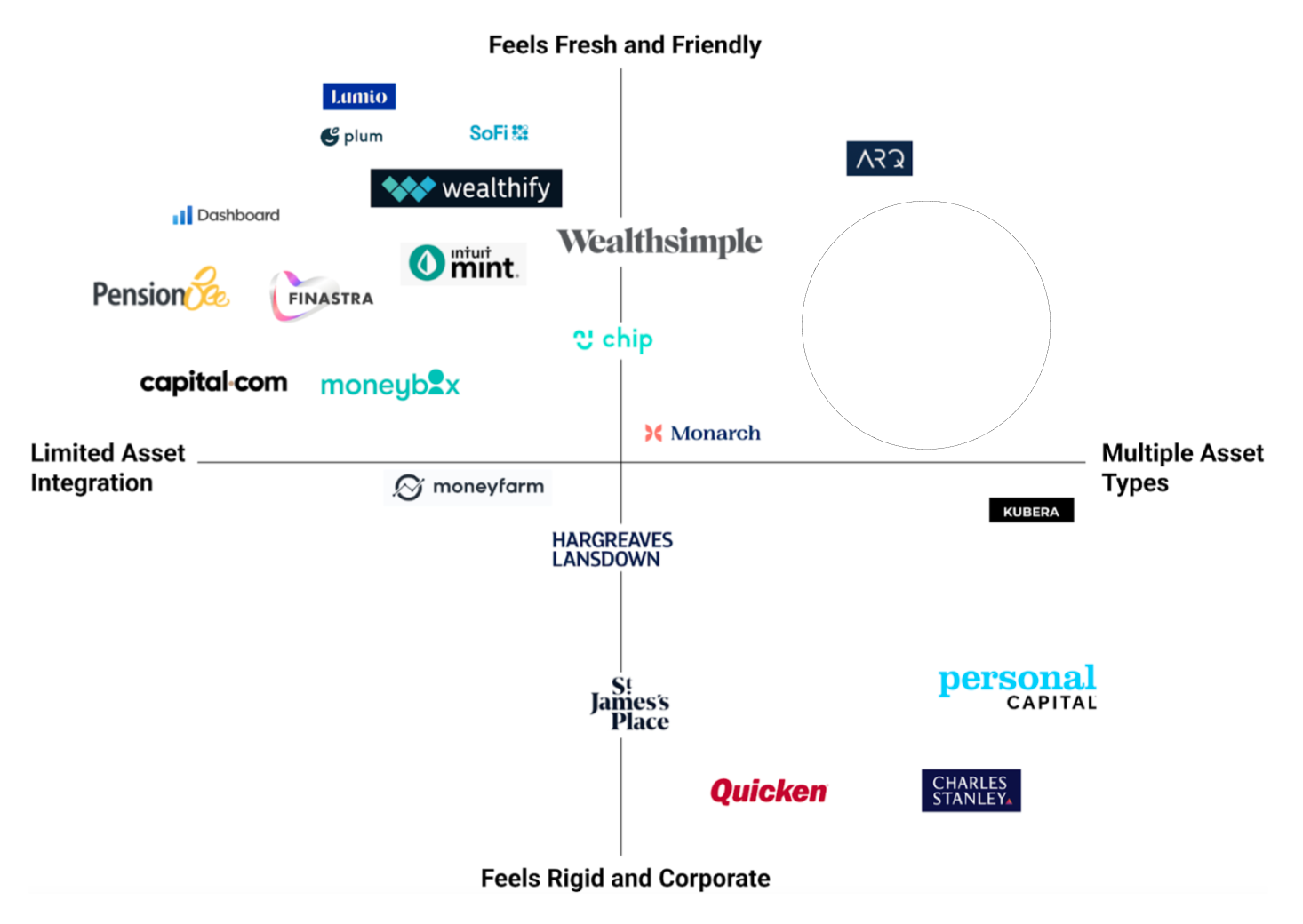
We found there was a gap in the market for a product that would allow users to integrate multiple assets on one platforms, whilst retaining a ‘fresh and modern’ feel.
Redefining the problem
Discover
Archetypes & Personas
Defining who WealthMaster’s users were
Having conducted extensive research to discover people’s current behaviours and the existing competition, we now needed to define the various different ‘types’ of investors there were. This would help us understand the current process each user takes in tracking and managing their finances, what the main issues were that they faced and subsequently who the primary user of the product would be.
Our research concluded there was a fragmented customer-base:
We established there were 6 different archetypes; all with different financial situations and each with distinctive behaviours and attitudes in terms of their approach to investing.

The Curious Newbie
The Long-Term Risk Averse
The Risk Taker
The Opportunist
The Invested Investor
The Methodical and Detailed
We defined the current financial situation each were in, how they managed and/or tracked their finances, and what their long-term goals were. Having done this, we could identify two archetypes that had the greatest user needs for a product to help them manage their finances but would also provide significant business value; this was the Methodical and Detailed Investor (our primary user) and the Opportunist (our secondary user).
Personas
Understanding who our primary and secondary users were
In order to maximise the value of the product we delivered, we needed to clarify in detail who these users were, understand the current process they were going through and identify exactly where in the process their experience was declining. To do this we created a persona of both the methodical and detailed investor and the opportunist.
The Methodical and Detailed Investor

Information:
Sam
Financial Director
Income : £120,000 per annum
His current situation:
Owns multiple assets (both financial and physical) across a variety of different platforms
Manually tracks asset performance through an Excel spreadsheet
Uses this data to extrapolate total values and projections of his whole portfolio
Inputs data on a weekly basis
“Every week I find an hour to log into all the accounts and tally things up, but it’s all entirely manual.”
The Opportunist
Information:
Janine
Senior Product Manager
Income: £75,000 per annum
Her current situation:
‘Hands-on’ approach to personally managing her investments
Constantly learning about growth markets
Aiming to accumulate wealth faster and diversify her portfolio
Lacks an investment strategy, time and is increasingly frustrated at investment and management fees

“I like to do research before investing…diversification is definitely the key”
Task Analysis & Experience Mapping
Understanding Our User Journey’s
To understand in detail the current process our users were going through to track track and manage their finances, we had to do a detailed breakdown of the current process into individual ‘step-by-step’ stages. This would allow us to understand exactly where in the process our users were experiencing the most issues and identify where the greatest pain points were. To do this, we completed two different task analysis, one each for Sam and Janine.
1. Sam (The methodical and detailed investor): logging weekly financial data in Excel
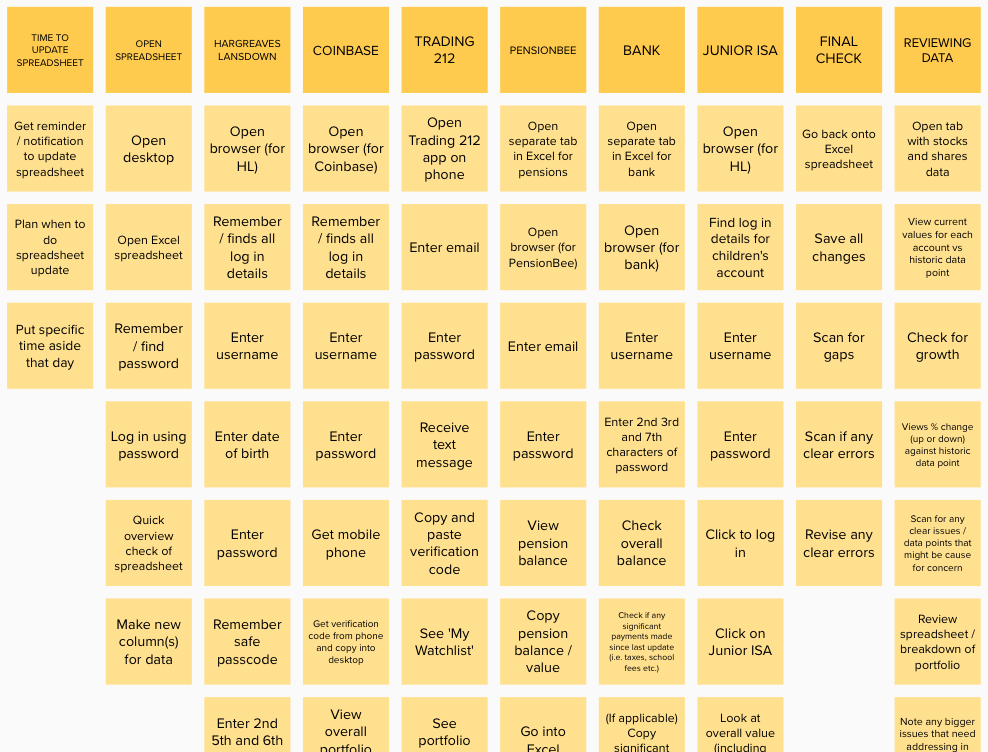
We found there were over 50 steps he had to take to input all this data. The process involved having to log into multiple platforms, remembering different account details and having to make sure all data was inputted correctly.
We drew out an empathy map of this process and found there were multiple times in Sam’s process that his experience declined. The overall process took time and effort, there was a high margin for error and it was highly repetitive process.
2. Janine (The opportunist): researching for new investment opportunities
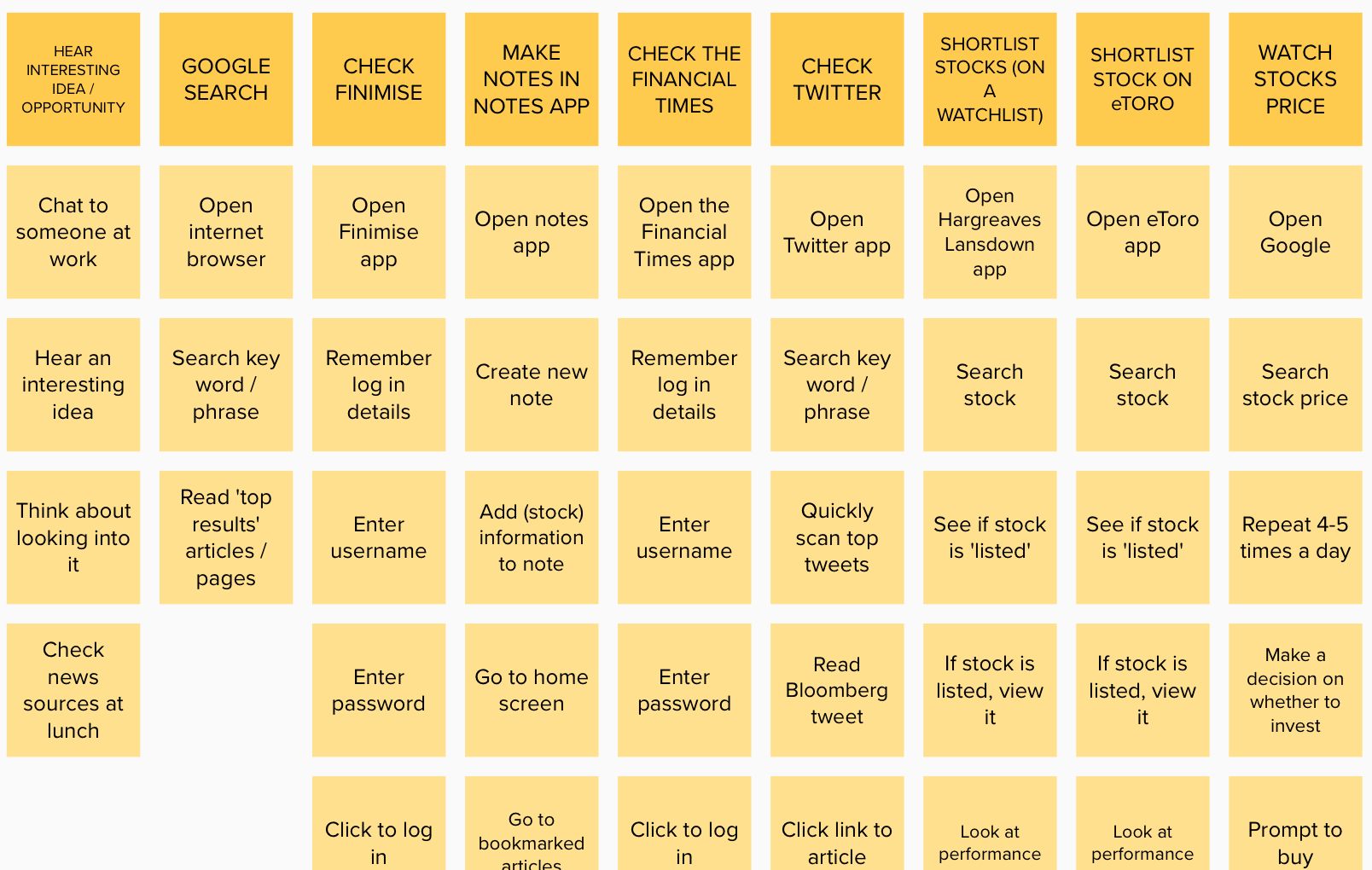
Again, we found there were multiple steps that she was taking in order to accumulate a sufficient level of knowledge before she could make an investment decision.
Logging into and checking multiple new sources, shortlisting potential stocks on a watchlist and checking stock prices was a lengthy and time-inefficient process.
Prioritising our main user
Having completed these two task analysis, we realised whilst Janine (The Opportunist) would be good user to target for ‘investment opportunity’ purposes later on, Sam (The Methodical and Detailed Investor) would provide the greatest business value with the core product we wanted to build.
For this reason, as well as time restraints, we decided to prioritise our focus on building a product that would replace Sam’s current process of inputting all investment data in an excel spreadsheet to get a financial overview, projections and analytics. This would have to be less time-consuming, reduce inaccurate data inputting and provide an overall more efficient process for users to track and manage their investments and finances.
Jobs-to-be-done
Defining core product features
Before starting to design, we had to define some key jobs our product was going to have to perform.
When users get an overview of their finances and investments they want to be able to see their whole portfolio broken into sections with different ‘totals’ so they can get a better idea of how their finances are divided.
Control
When users look at their total financial picture, they want to track investments and view performance in relation to historical data so they can make sure their money is working for them.
Knowledge
When users view their assets, they want a realistic overview that shows the liquid worth of their tangible assets so they can secure finances for their current situation and mitigate against future liabilities.
Flexibility
Problem Statement
Revisiting the challenge
Having undertaken extensive research and used multiple process tools, we now redefined the problem:
WealthMaster needs to be a platform where users can track and analyse their current finances and investments because people want to have control of their future financial security.
Ideating a solution
Develop
Wire framing
Sketching
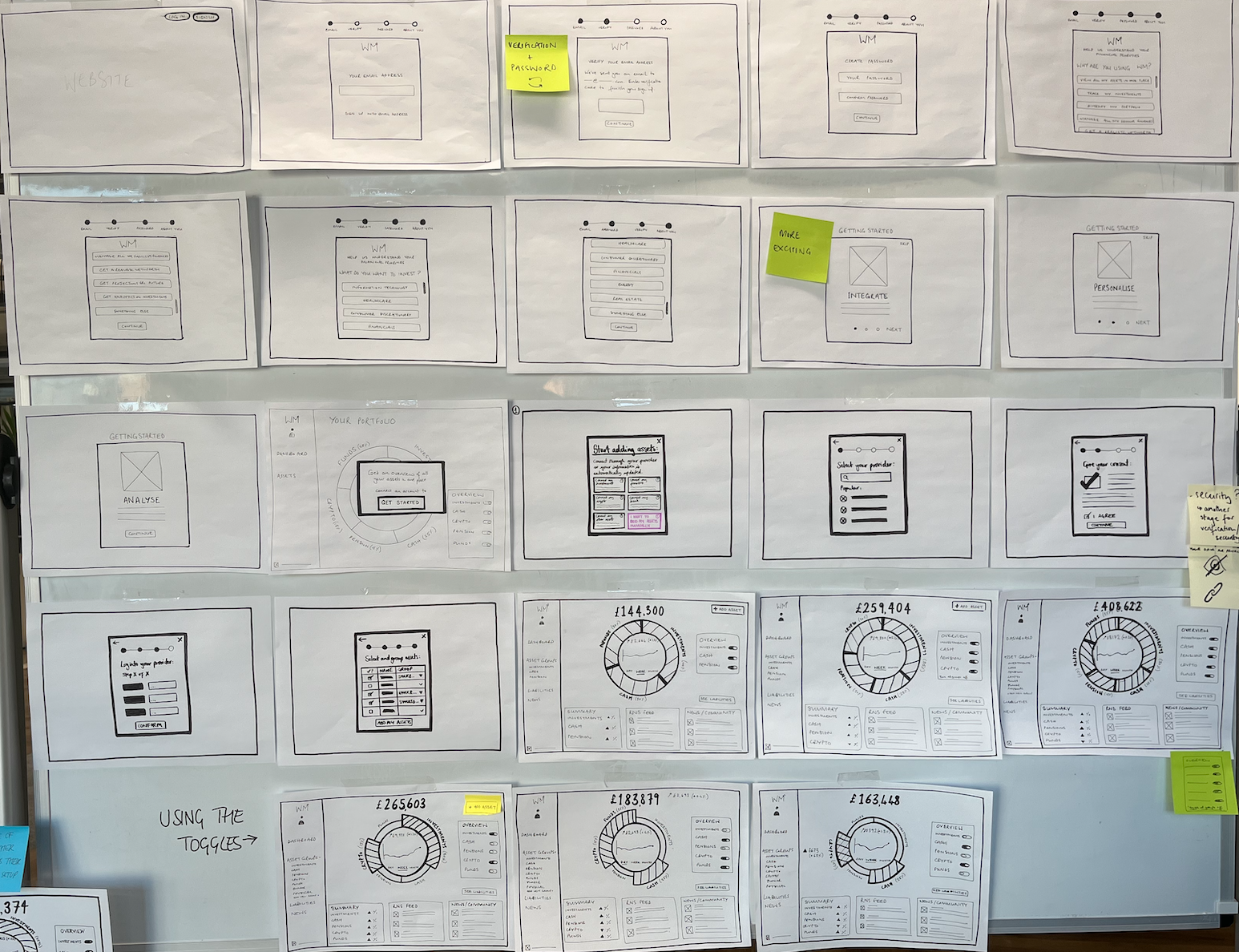
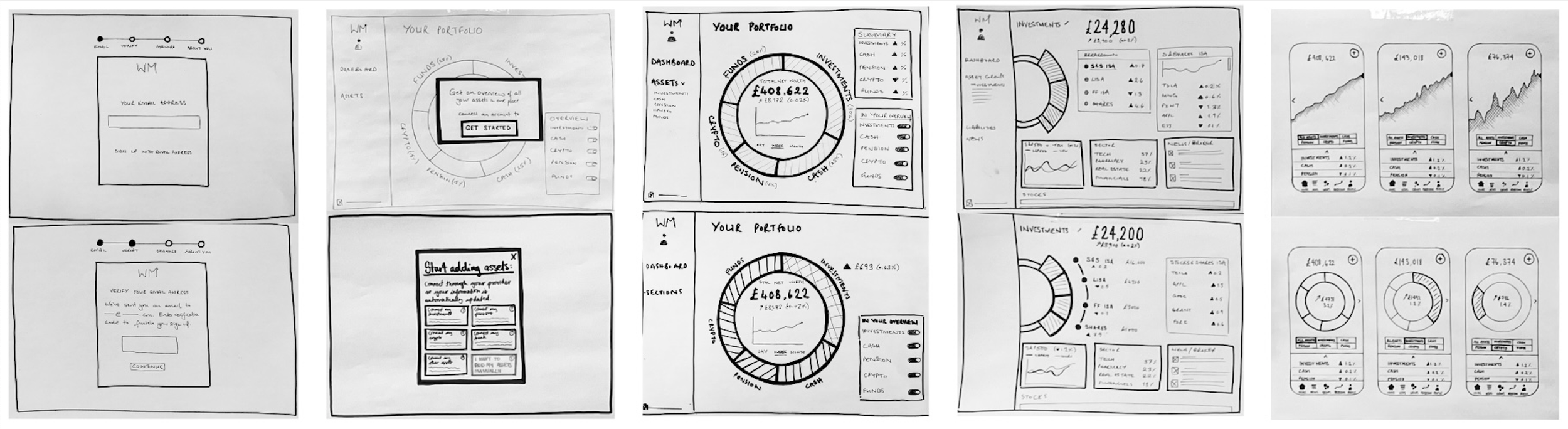
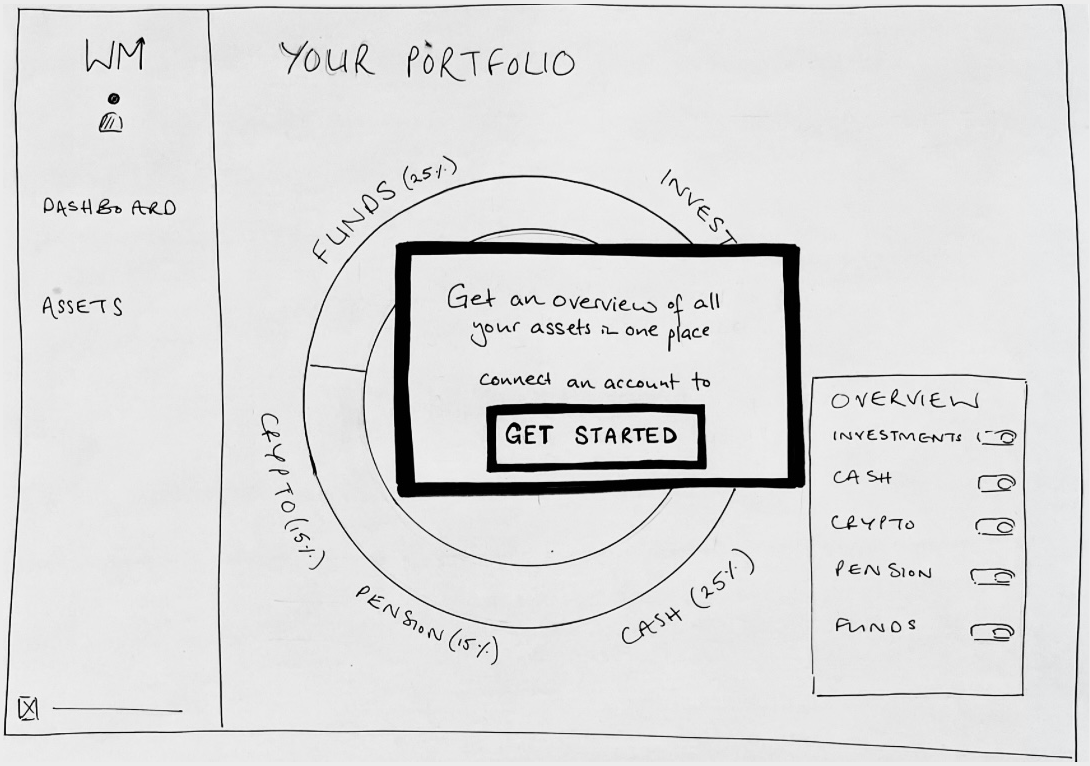
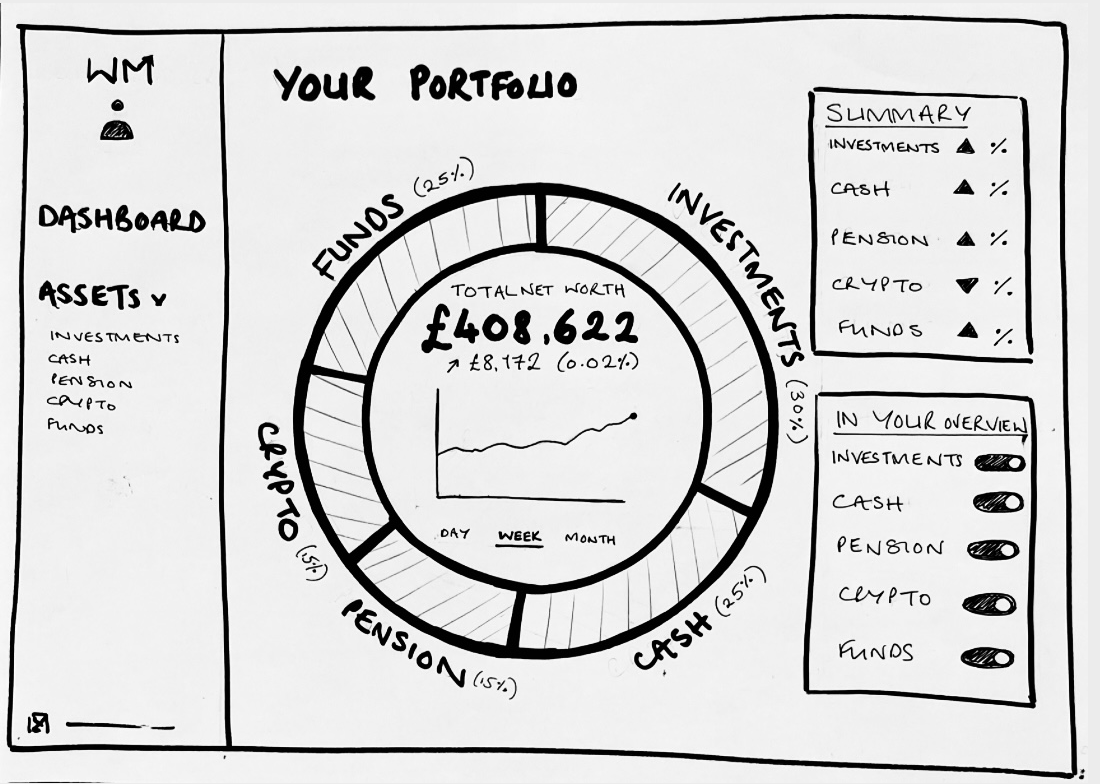
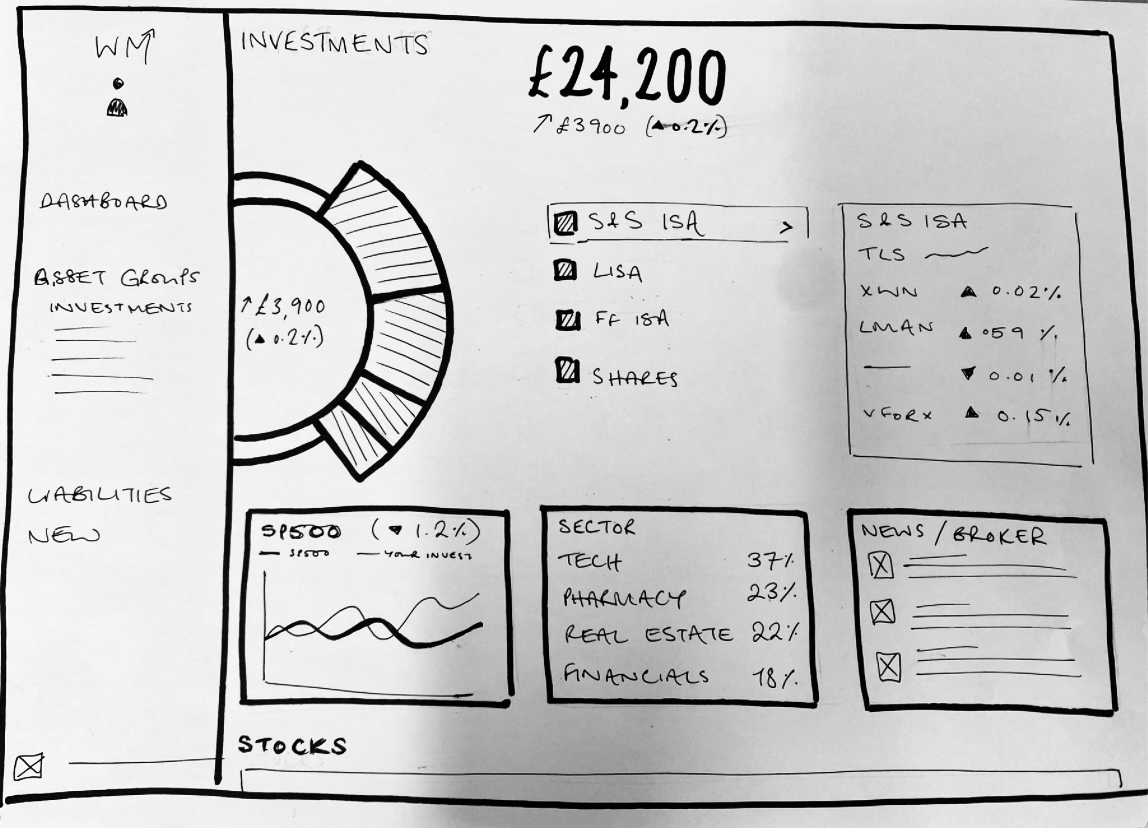
We started by creating high-level sketches of the platform, including the sign-up process, adding assets, getting an overview and navigating through to specific asset group pages. We sketched this out for both desktop and mobile as we had found there were user cases for both devices.
Figma
Taking it digital
We continued to ideate and sketch out ideas until we were happy with our final designs. We decided on a user flow, from initial sign up to navigating around the platform, to ensure that everything we would build into the platform had been thoroughly thought through and refined.
With these, we were then able to starting creating low-fidelity wire frames in Figma, before building these up to a high-fidelity prototype.
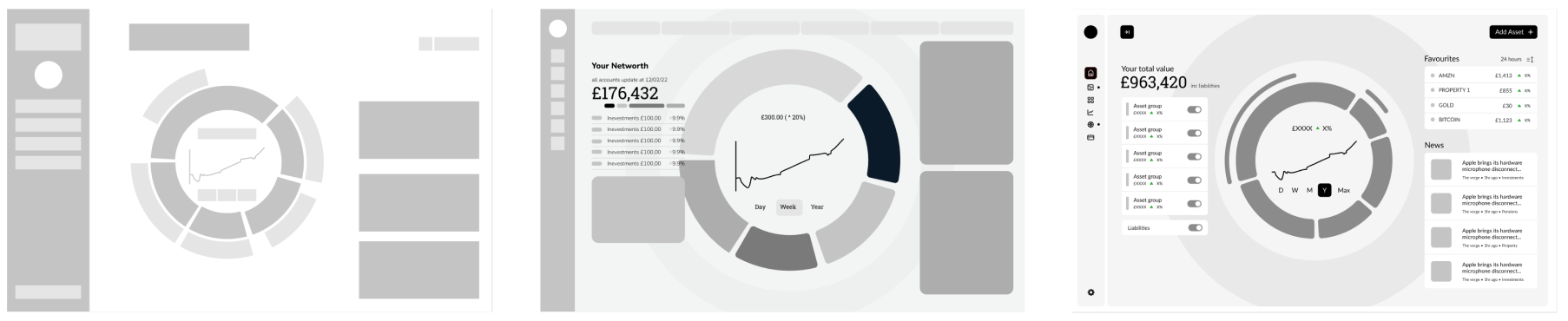
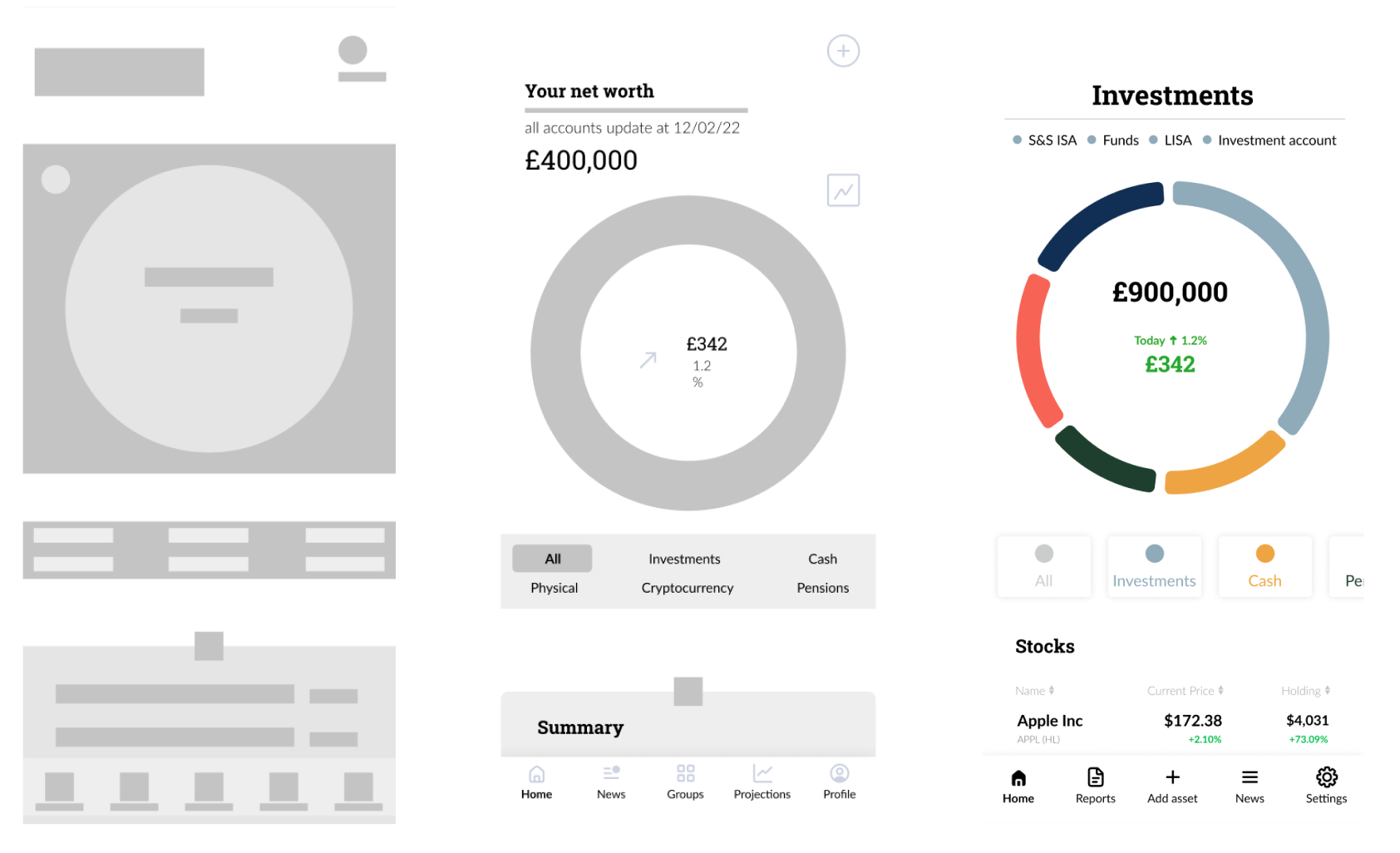
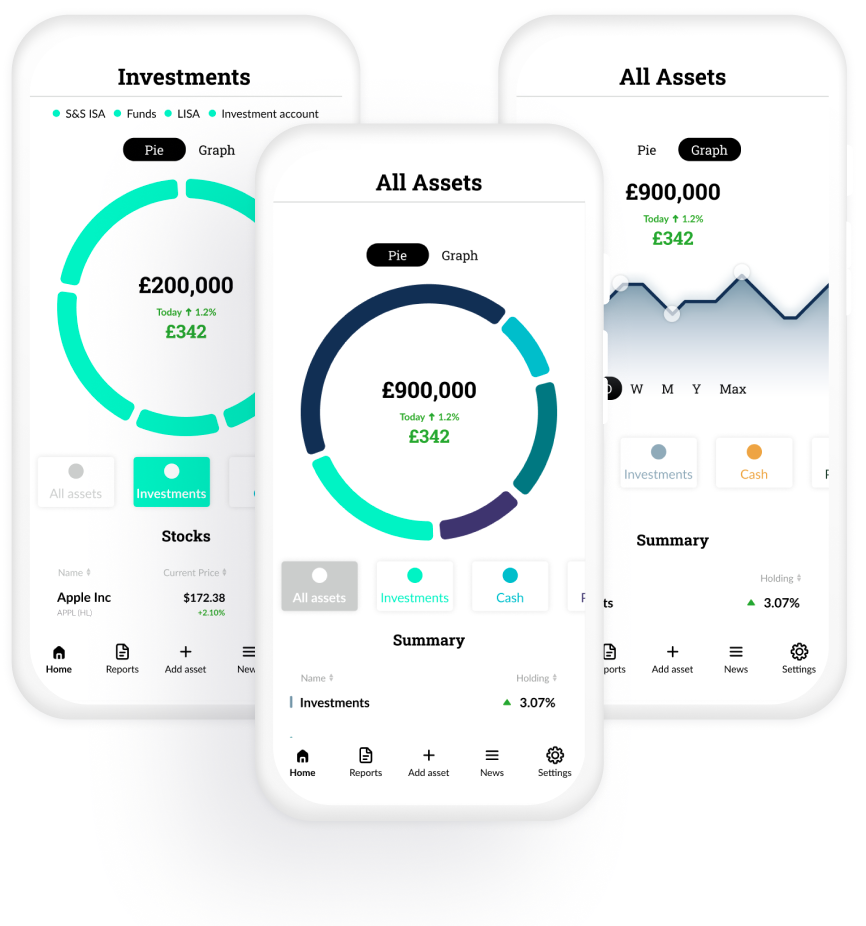
At this point, we had built low-fidelity prototypes for both desktop and mobile. However, with the time that we had we wanted to make sure we we delivered a high quality product. We therefore decided to focus primarily on developing the desktop version of the platform, with the intention of looking at developing the mobile version in the future plans for the product.
User Testing
Refining our design
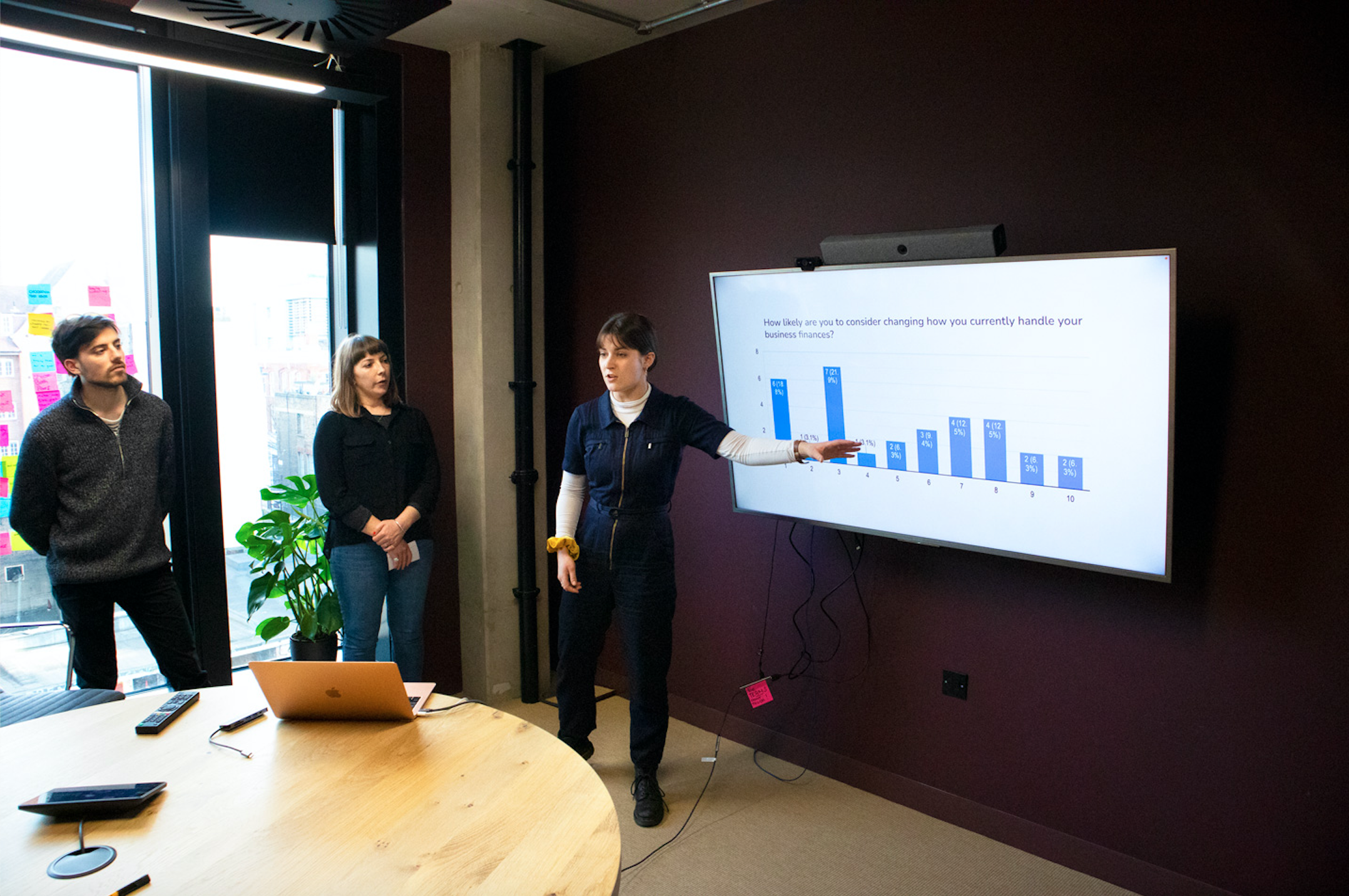
At every stage, from low-fidelity wireframes through to our high-fidelity prototype, we carried out user testing. As a result, we were able to continuously develop and adapt our designs. There were significant changes we made to the navigation bar, on-boarding steps and various functionalities such as that of viewing liabilities.
Presenting the solution
Deliver
Stakeholder presentation
Our Final Product
Having built a high-fidelity prototype, done user testing and made relevant changes from the feedback, we were ready to present our final product to the stakeholder.
Signing up and adding assets
We wanted to keep the sign up process and adding new assets to the dashboard very clear and simple, with as few steps to complete as possible.
Users have the option to connect accounts with popular providers or to manually add assets themselves, before assigning each asset to an asset ‘group’.
Navigating the dashboard
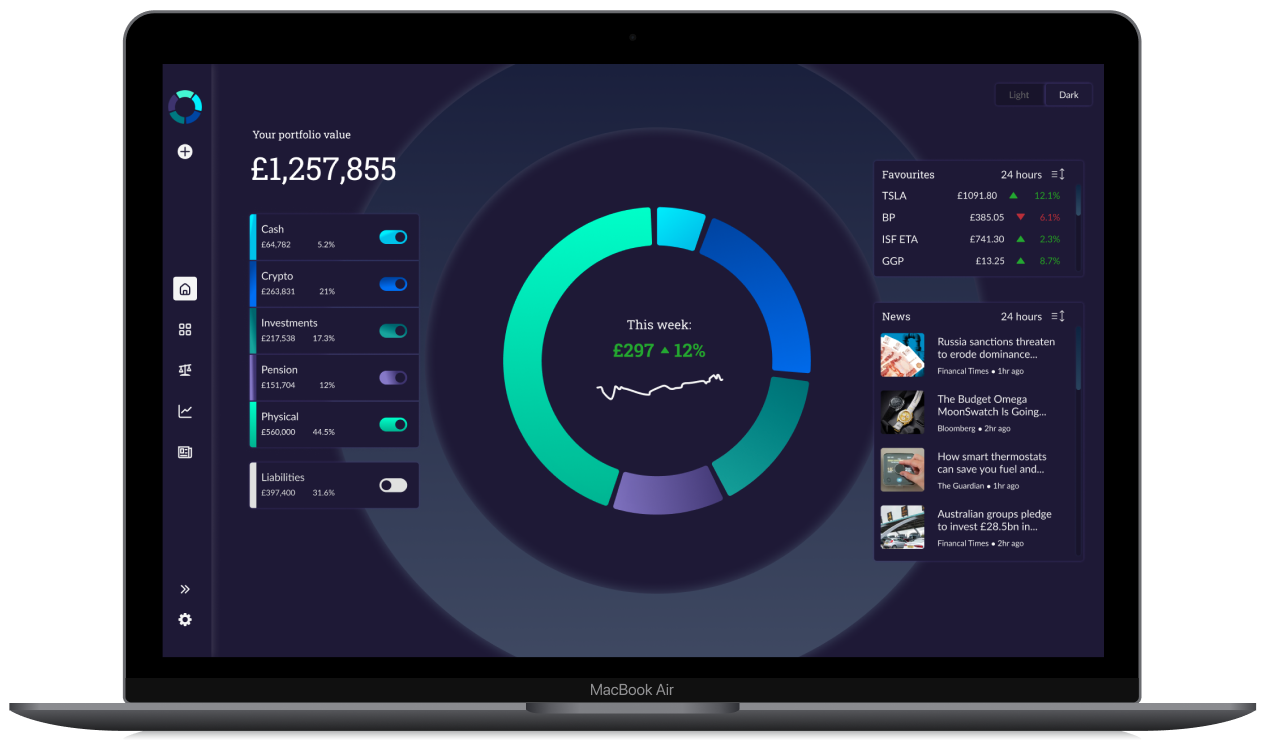
Users can see a clear overview of their whole wealth portfolio, broken down into different asset groups.
They can easily ‘toggle’ on and off different groups in order to see different overviews.
There can view asset performance over time, as well as turn on liabilities to get a more realistic net worth.
Viewing individual asset group pages
Users can a detailed breakdown of the individual assets and accounts that they hold within each group.
They can also see the breakdown by sector, performance over time and all the stocks they’re invested in.
Users can get details on individual stocks which can be favourited and viewed on the dashboard homepage.
Dark Mode
Mobile
Breaking it down
The central piechart/graph provides an overview of all assets in on place, so users can quickly see their whole wealth portfolio
Control
Ability to ‘toggle’ different overviews so users can view investment portfolio how they want to
Flexibility
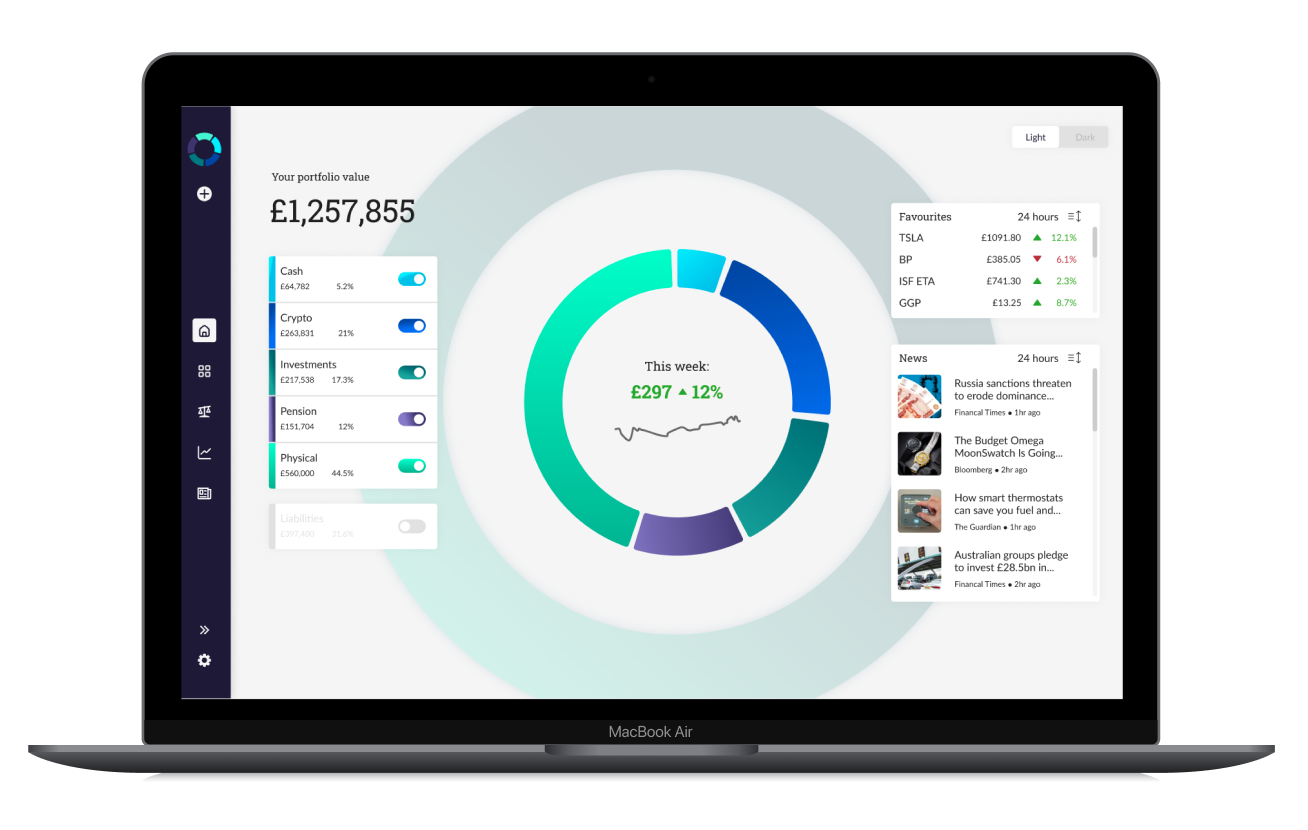
News, detailed asset breakdowns and stock information so users can make informed decisions on their investments
Knowledge
Feedback
What our client thought
We presented the final product back to our client as well as the research and design process we had undertaken over the 6 weeks and the feedback we got back was overwhelmingly positive.
“The team did a fantastic job building an MVP for my product! Demonstrating incredible leadership and passion I was impressed by the degree of ownership and commitment they took in the preparation of a prototype for a considerably complex product. Leading with curiosity and role modelling great stakeholder engagement skills, the team effectively captured and synthesised a relatively large data set into a practical outcome and communicated the results in a highly engaging way.”
Product Roadmap
The Next Steps
We developed a product roadmap for our client, prioritising core tasks before looking at other product features that should be developed further down the line.
1-3 months
Mobile app design
Forecasting portfolio growth
Further usability testing
3-6 months
Personalised performance reports
Revisit subscription pricing
User data collection
6-12 months
Enabling of automated trading
Open Banking integration
Portfolio guidance based on analytics